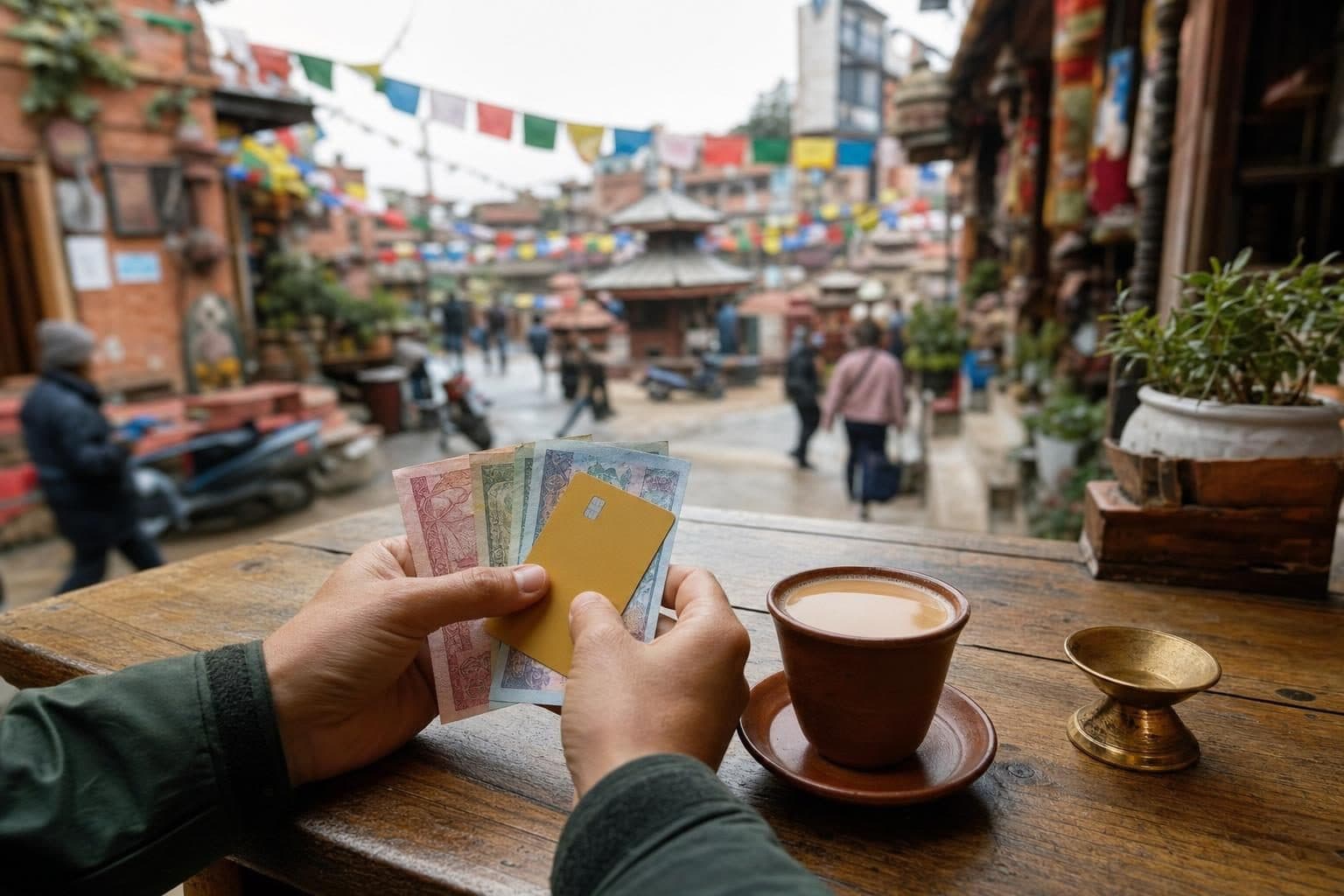
Nepal still runs mostly on cash, but getting it is easy: ATMs are everywhere in Kathmandu and Pokhara, and Visa and Mastercard work in them. The costs are in the details — a flat fee on every withdrawal, low per-withdrawal limits, and card surcharges in shops. Here is how to pay for a trip to Nepal without wasting money, with the rule changes from 2026.
The short version
What to do with money on a Nepal trip.
- Bring a Visa or Mastercard debit card and withdraw rupees from ATMs. Take out the maximum each time: local banks charge a flat fee of roughly NPR 500–800 per withdrawal, whatever the amount.
- Carry some US dollars in clean, recent notes as a backup — enough for a few days and your visa fee.
- Cash is king outside hotels, trekking agencies and upmarket restaurants. On trekking routes it is often the only option.
- When a card machine or ATM offers to charge you in your home currency, say no and pay in Nepali rupees.
- Indian visitors can pay by scanning shop QR codes with UPI apps, and since July 2026 can bring ₹200 and ₹500 notes up to ₹25,000.
ATMs: limits, fees and which to use
Nepali bank ATMs accept foreign Visa and Mastercard cards; look for the logos on the machine. Each bank sets its own limit for foreign cards, usually between NPR 20,000 and NPR 35,000 per withdrawal, and charges its own access fee on top of whatever your bank charges. Because the fee is flat, one withdrawal of NPR 35,000 costs far less in fees than three of NPR 10,000.
Use ATMs attached to a bank branch, in daylight, so you can get help if the machine keeps your card. In the hills, ATMs thin out quickly and often run out of cash or lose power — withdraw what you need for a trek before leaving Kathmandu or Pokhara.
| Charge | Typical amount |
|---|---|
| Nepali bank's ATM fee | NPR 500–800 per withdrawal |
| Limit per withdrawal | NPR 20,000–35,000, depending on the bank |
| Your own bank's foreign fee | 0–3% plus any fixed fee — check before you go |
Can you use your card in Nepal?
Yes, with limits. Visa and Mastercard — including travel cards such as Wise, Revolut and Monzo, and ordinary bank debit and credit cards — work in ATMs and at card machines in hotels, trekking agencies, supermarkets and many restaurants in Kathmandu and Pokhara. American Express is accepted in far fewer places. Small shops, taxis, local buses and teahouses on trekking routes generally take cash only.
Many businesses add a surcharge of around 3–4% for card payments, so ask before you pay. And always choose to be charged in Nepali rupees: if the machine offers your home currency, the conversion rate is set by the shop's bank and is usually worse than your own card's.
Tell your bank you are travelling, and bring two cards on different networks — ideally one Visa and one Mastercard — in case one is blocked or swallowed by an ATM.
QR payments: UPI, Alipay+ and UnionPay
Almost every shop in Nepal displays a Fonepay QR code, and some foreign payment apps can now scan it. Indian visitors have been able to pay with UPI apps since March 2024. Alipay+ wallets also work, and in May 2026 Fonepay added UnionPay, used by many travellers from China and elsewhere in Asia. Visitors from most other countries can't pay by QR yet: Nepali wallets such as eSewa and Khalti need a Nepali bank account or mobile number to top up.
How much cash to bring, and which currency
US dollars are the easiest foreign currency to change, and euros and pounds are widely accepted in Kathmandu and Pokhara too. You can pay the visa-on-arrival fee in cash or by card; carry the fee in dollars in case the card machines are down. Beyond that, bring enough cash for two or three days as a backup if your cards stop working. There's no need to carry your whole budget.
Bring clean, undamaged notes. Money changers often refuse torn, written-on or old-series banknotes, and larger notes sometimes get a better rate than small ones.
Foreign currency above USD 5,000 (or equivalent) must be declared at customs when you arrive.
Nepal Rastra Bank publishes official exchange rates every day, and banks and licensed money changers price close to them. Check today's rate before you change money, so you know what a fair offer looks like.
Changing money: airport, banks and Thamel
There are exchange counters and ATMs in the arrivals hall at Kathmandu airport. The rates there are usually worse than in town, so change or withdraw only what you need for the first day — your taxi, a SIM card and a meal. Banks and licensed money changers in Thamel, Lakeside in Pokhara and other tourist areas offer better rates; the licence and the day's rates are usually displayed at the counter.
Only change money with banks and licensed changers, and keep the receipts. When you leave, banks will only change Nepali rupees back into foreign currency against those receipts, and only part of what you exchanged — so try to spend your rupees before you fly home.
For Indian visitors: rupees, ₹500 notes and UPI
Indian rupees are widely accepted in Nepal at the fixed rate of ₹1 = NPR 1.60. In July 2026 Nepal Rastra Bank lifted its ban on ₹200 and ₹500 notes: Indian and Nepali nationals can now carry them into and out of Nepal up to ₹25,000 per person in total, as long as the notes were issued after India's November 2016 demonetisation. ₹2,000 notes are still not allowed. Notes of ₹100 and below remain fine.
UPI is often the easiest option: scan the shop's Fonepay QR code with a UPI app such as Google Pay, PhonePe or Paytm — if your app supports international UPI — and the amount is converted from rupees automatically.