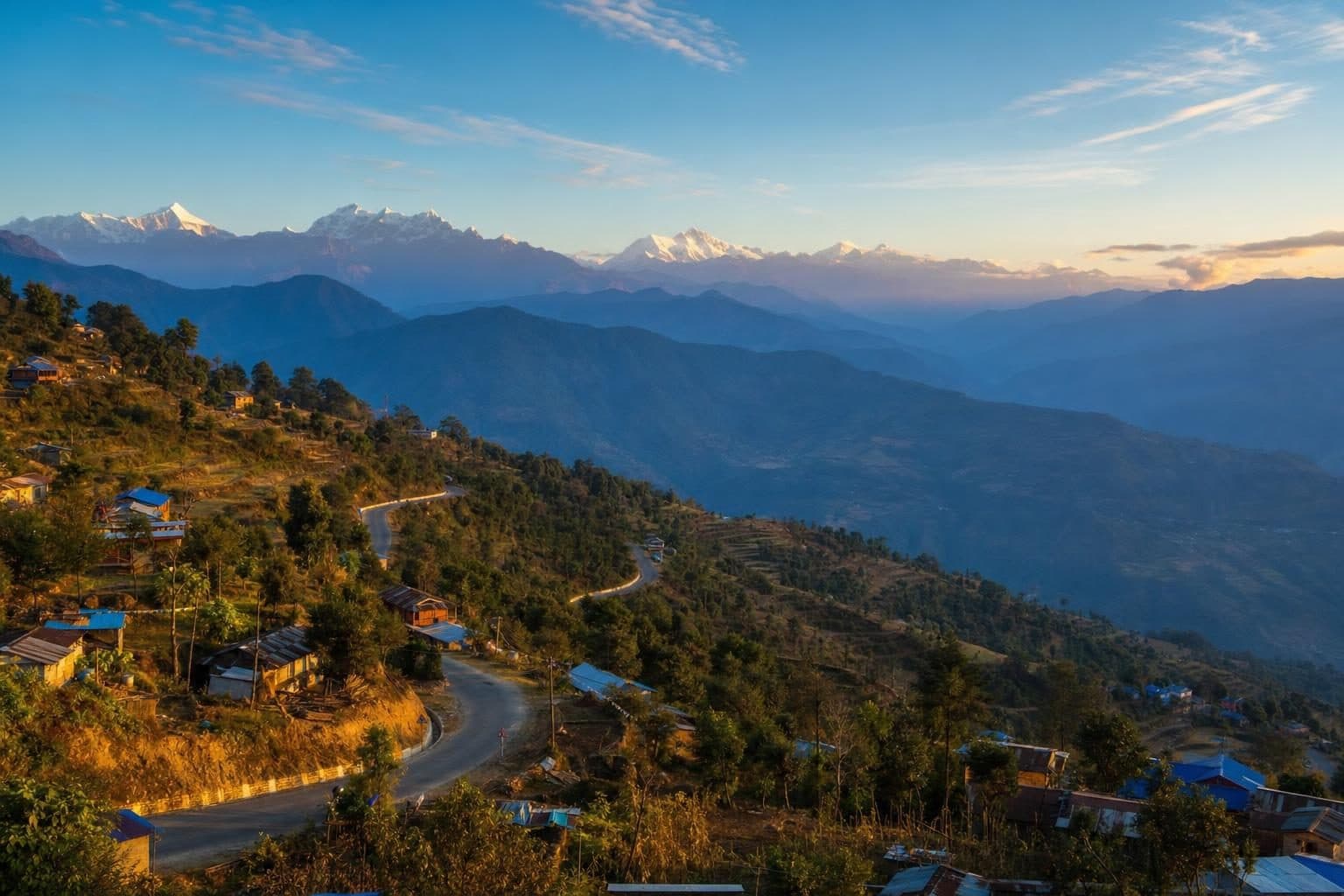
Nepal is small on a map and slow on the ground. A 200 km hop between two of its best-known places can take most of a day, and that, more than any list of sights, is what shapes a trip here. This guide sets out the places worth your days, what each charges to get in, how the journey actually works, and the two quirks — monsoon-hit highways and a two-tier fare system — that most travel pages leave out.
Start here
Five things that decide what your trip can contain.
- Most trips are built from three places — the Kathmandu Valley, Pokhara and Chitwan — because they are the ones the roads and flights actually connect.
- Distances mislead. Kathmandu to Pokhara is about 200 km and takes most of a day by bus, or 25 to 30 minutes by plane.
- October and November are the clearest months, then March and April. From June to September the rain hides the mountains and breaks the highways.
- Almost every site charges an entry fee, paid in cash at the gate. Budget for them separately from your hotel and transport.
- On domestic flights foreigners pay a separate, higher fare in US dollars. It is official, not a scam at the counter.
What fits in the days you have
Work backwards from your days, not from a list of places. Each move between regions costs either a day on the road or a flight and half a day of airport time.
| You have | A trip that works | What to leave out |
|---|---|---|
| 4–5 days | Kathmandu Valley only: the three Durbar Squares, Pashupatinath, Boudhanath, Swayambhunath, a night in Nagarkot or Bhaktapur | Pokhara. Two days of travel for two days there is a poor trade |
| 7–8 days | Valley plus Pokhara, flying one leg and driving the other; or Valley plus Chitwan | Trying to fit both Pokhara and Chitwan as well as the Valley |
| 10–12 days | The classic loop: Valley, Pokhara, Chitwan — with Bandipur as a stop on the road between | Lumbini, unless it is the reason you came |
| 2 weeks | The loop plus a short trek from Pokhara, or Lumbini, or Bardia for wildlife without the crowds | Everest Base Camp — that trek alone needs about two weeks plus spare days |
Two things that decide your plan
First, the highways. The Prithvi Highway carries almost all road traffic west from Kathmandu to Pokhara, and the Narayanghat–Muglin road branches off it to Chitwan and Lumbini. Both close repeatedly in and just after the monsoon. In September 2026 a landslide at Krishnabhir shut the Prithvi Highway for eighteen days, leaving about 150 Pokhara tourist buses idle while air passengers nearly tripled to 3,500 a day; it reopened, then heavy rain closed sections again a week later. If you travel between June and early October, check the road before you book a bus, and keep a spare day.
Second, the fares. Nepal runs a two-tier system on domestic flights: foreigners pay in US dollars, typically two to three times the Nepali fare. On Kathmandu–Pokhara that was about USD 100 against NPR 4,000 when the Kathmandu Post examined it in March 2025. A minister promised to scrap it in April 2026, but no decision has been made and airlines are resisting. Budget for it rather than hunting for the Nepali price.
| To | Flight time | For |
|---|---|---|
| Pokhara | 25–30 min, 17+ a day on Buddha Air alone | Annapurna views, lakeside, paragliding |
| Bharatpur | 25 min, 6 a day | Chitwan National Park |
| Bhairahawa | 30 min, 11 a day | Lumbini, about an hour away by road |
| Janakpur | 30 min, 5 a day | Janaki Mandir and the Mithila towns |
| Bhadrapur | 45 min, 5 a day | Ilam tea hills, 3 hours on by road |
| Nepalgunj | About 50 min, 6 a day | Bardia National Park; connects on to Rara |
You can now start your trip outside Kathmandu. flydubai has flown Dubai to Pokhara daily since 23 September 2026 — the airport's first scheduled international service — and Thai AirAsia resumes Bangkok to Bhairahawa, for Lumbini, twice weekly from 26 October 2026. Visa on arrival is issued at all three international airports.
The three places most trips are built from
The Kathmandu Valley holds seven UNESCO monument zones within an hour of each other: the Durbar Squares of Kathmandu, Patan and Bhaktapur, the temple complex at Pashupatinath, the stupas of Boudhanath and Swayambhunath, and Changu Narayan on its ridge. Each charges its own fee at its own gate — there is no combined ticket, and the seven together come to about NPR 5,900 for a foreign visitor.
Pokhara is the second stop for almost everyone: a lake, the Annapurna wall behind it, and the start of most short treks. The International Mountain Museum charges foreigners NPR 750 — worth knowing, because nearly every blog still prints NPR 500. Tandem paragliding from Sarangkot became far cheaper after the civil aviation authority stopped the operators' association fixing prices; Republica reported flights at NPR 3,000 to 4,000, but quotes vary and flying is occasionally suspended altogether, so arrange it when you arrive rather than months ahead.
Chitwan is the wildlife stop, and its calendar has a gap nobody writes about: jeep safaris inside the core park close for the monsoon — in 2026 from 30 June, reopening around Dashain in October. Buffer-zone safaris keep running. Park entry is NPR 2,000 for foreigners and NPR 1,000 for SAARC nationals, with a separate NPR 5,000 charge for a tourist jeep. The 2026 census counted 145 tigers in the Chitwan–Parsa landscape, up from 128.
Elephant rides are half-banned, and the difference matters. They have not been allowed inside Chitwan National Park for about fifteen years, but they still run in the buffer-zone forests around Sauraha, under a December 2025 Supreme Court order telling authorities to find alternatives. If you would rather not ride, jeep and canoe safaris see as much.
Worth the detour
Lumbini, the birthplace of the Buddha, is a long way from everything: about 300 km and eight to eleven hours by road, or a 30-minute flight to Bhairahawa and an hour on. One conservation fee covers the Sacred Garden and the Maya Devi Temple — NPR 700 for foreigners, NPR 400 for SAARC nationals, with a lower special rate for Indian nationals — plus NPR 100 a day if you carry a still camera. The monastic zone is a long, hot, shoeless walk; take the free electric bus or hire a rickshaw, and wear socks.
Nagarkot, 32 km from Kathmandu at 2,195 m, is the easy mountain view — although the mayor of Changunarayan said publicly in December 2024 that visitor numbers had fallen partly because the sunrise views are no longer reliably visible. Treat it as a quiet hill night with a chance of mountains, not a guarantee. Nepal's longest zipline, 2,250 m, runs here at USD 50 for foreigners.
Bandipur sits 8 km above the Kathmandu–Pokhara highway at Dumre, which makes it the natural break on that drive. Its main bazaar is closed to vehicles: buses stop at the edge and you walk in on stone paving, past Newar houses, with Dhaulagiri through to Ganesh Himal along the skyline. There is no town entry fee. Local buses climb from Dumre about every half hour and take around 30 minutes.
If you have longer, or want fewer people
These four take real effort to reach, which is exactly why they are quiet.
| Place | Getting there | Worth knowing |
|---|---|---|
| Bardia National Park | Fly to Nepalgunj (about 50 min), then 95 km and roughly 3 hours | 112 tigers in 2026, down from 125 — the only park to fall. Under 7,000 foreign visitors a year against Chitwan's 75,000 |
| Ilam | Fly to Bhadrapur (45 min), then 77 km and about 3 hours north | Tea hills and the Antu Danda sunrise. The monsoon is the tea-processing season — green hills, no mountain views |
| Janakpur | Fly (30 min) or about 225–240 km on the BP Highway, 7–9 hours | Janaki Mandir, Nepal's largest temple, finished in 1874. Rooms vanish during Vivah Panchami, around 13–14 December 2026 |
| Rara Lake | Fly to Nepalgunj, then Talcha (35 min, 4 flights a week), then 2–2.5 hours uphill on foot | Nepal's largest lake, 5.1 km long. Talcha airport is visual-flight only and shuts at 12:15 — keep spare days |
What it costs to get in
Entry fees are paid in rupees, in cash, at the gate. Carry small notes — change for a NPR 1,000 note is not always available at a park post or a temple door.
| Where | Foreigners | SAARC |
|---|---|---|
| Chitwan National Park (per day) | NPR 2,000 | NPR 1,000 |
| Bardia National Park | NPR 1,500 | NPR 750 |
| Rara National Park | NPR 3,000 | NPR 1,500 |
| Sagarmatha (Everest) National Park | NPR 3,000 | NPR 1,500 |
| Annapurna Conservation Area (ACAP) | NPR 3,000 | NPR 1,000 |
| Lumbini Sacred Garden (per day) | NPR 700 | NPR 400 |
| Kathmandu Valley, seven sites together | About NPR 5,900 | About NPR 2,150 |
When to go
October and November are the clearest and busiest months; March and April are the second window, hazier but warm, and the Terai parks are at their best for sightings in spring. The monsoon runs from about mid-June to mid-September and brings roughly four-fifths of Nepal's rain: mountains disappear behind cloud, highways slip, and Chitwan closes its core jeep safaris.
Two exceptions are worth planning around. The Terai — Lumbini, Chitwan, Bardia, Janakpur — is punishing from mid-April to mid-June; Bhairahawa hit 40.8°C in April 2026. And Rara is effectively cut off by snow in deep winter, when the road from Jumla can be under two feet of snow.
Travelling in the monsoon is not pointless — it is green, cheap and empty, and Bardia kept its safaris running through July 2026 when other parks closed. Just plan it around flights rather than long bus days, and do not count on seeing a mountain.