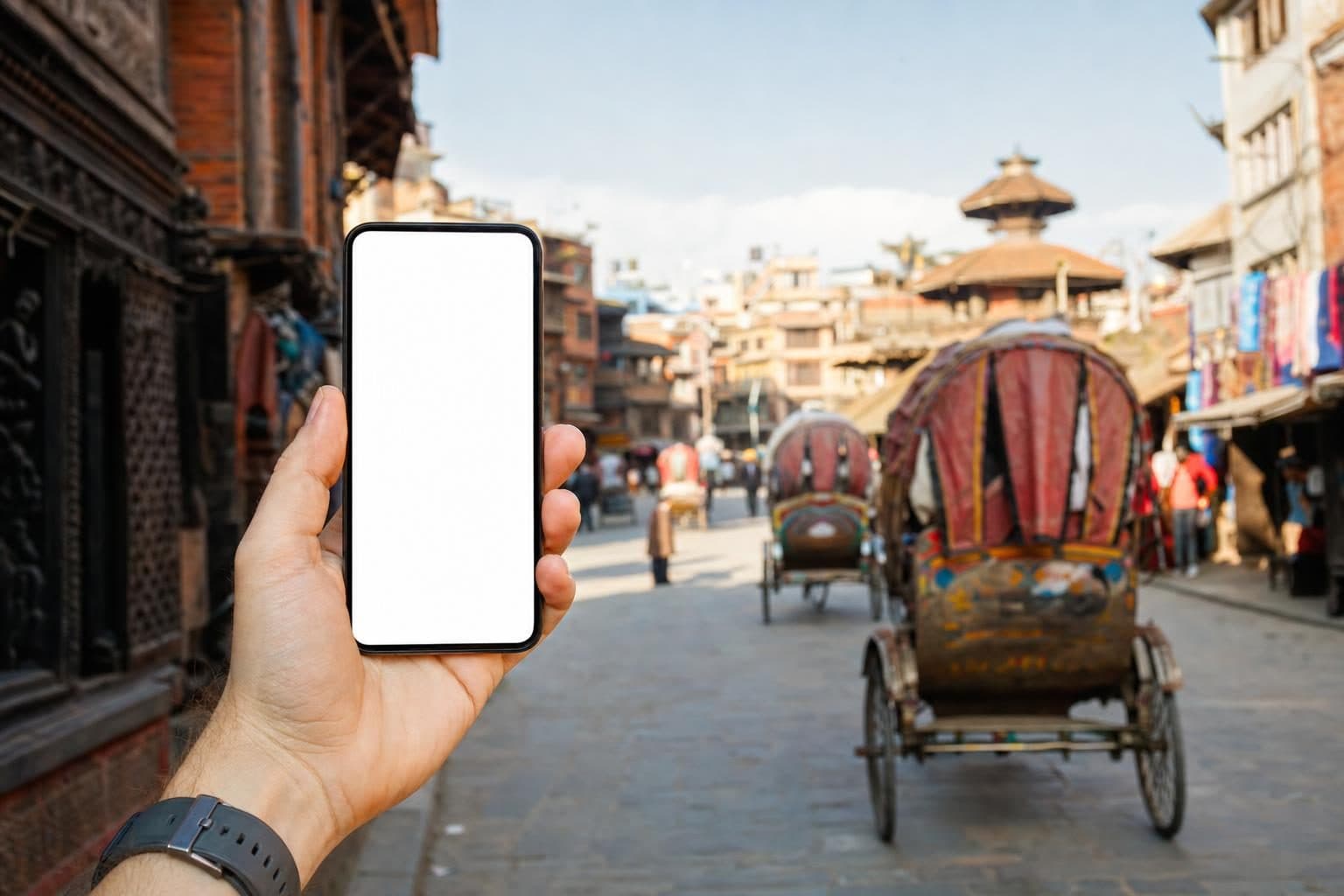
Most lists of apps for Nepal recommend things a visitor cannot sign up for. Nepal's payment wallets need a Nepali SIM registered to a Nepali identity, so eSewa and Khalti are closed to you before you start. What does work is a smaller, more useful set: ride apps that take cash, offline maps, one official weather app, and a tourist SIM. Here is what to install, what to skip, and the one rule that can cut your phone off mid-trip.
The short version
What to set up before you land.
- Uber launched in the Kathmandu Valley in mid-2026, and your existing account from home works — no new signup, no Nepali number.
- Pathao, InDrive and Yango cover more of the country. All offer a bike or a car, and all take cash, which matters when you have no local payment method.
- Don't bother with eSewa or Khalti. Both need a Nepali SIM registered in your own name; Khalti says so plainly in its own help pages.
- Download an offline map. Google Maps has walking and driving directions here but no live traffic layer, which is exactly what Kathmandu needs.
- If you use a Nepali SIM for more than 15 days, your phone's IMEI must be registered or the network cuts it off.
Getting a ride
Every one of these apps lets you choose a bike or a car, and every one takes cash at the end of the ride. That combination is what makes them usable for a visitor: you can order a ride on day one without a Nepali bank account, a local wallet or a card on file. A bike is cheapest and quickest through Kathmandu traffic, if you are travelling light; take a car with luggage, in the rain, or after dark.
Uber is the easy one, because there is nothing to set up. It went live in the Kathmandu Valley in May and June 2026 with car and bike options, and it is the only app here that works from the account you already have. It covers the valley only, and it operates through a local partner rather than a registered Nepali subsidiary — worth knowing, though it does not change your ride.
| App | Where | Notes |
|---|---|---|
| Uber | Kathmandu Valley | Your home account works. Car and bike |
| Pathao | 21 cities, including Pokhara, Chitwan, Butwal, Biratnagar | The widest coverage. Cash or its own wallet |
| InDrive | Kathmandu, Pokhara, Bharatpur | You name your fare and drivers accept or counter. Cash |
| Yango | Kathmandu | Cash at launch |
Pokhara has rules that Kathmandu does not. Gandaki Province began enforcing ride-hailing regulations in February 2026, capping app trips at 20 km on a bike and 50 km in a car — so you cannot book a long intercity ride on an app there. In Kathmandu the sector is legal but has no provincial rules at all, which means fares and complaints are whatever the app decides.
Paying for things
Nepal's own wallets are shut to visitors, and it is worth understanding why so you don't waste an afternoon trying. eSewa states that registration requires a Nepali SIM. Khalti's support page says that people living outside Nepal cannot sign up, because the account is tied to a Nepali mobile number. IME Pay no longer exists separately — it merged into Khalti in 2025. And the central bank has gone further: from October 2026 wallets require National ID verification, which closes the door harder.
What has changed instead is the other direction: paying a Nepali QR code with your own app from home. That works — but only for specific nationalities, which is the part nobody spells out.
- Indian visitors: UPI apps pay any Fonepay merchant QR, live since March 2024, up to about ₹100,000 a day. Merchant QR only, not person-to-person.
- Alipay+ wallets — Alipay, KakaoPay, GCash, Touch'n Go, AlipayHK, TrueMoney and others — work on both Nepali QR networks.
- UnionPay app users from China, Hong Kong, Macau and Singapore can scan Fonepay QR codes since May 2026. UnionPay cards have been accepted for years separately.
- Everyone else — British, American, Australian, European, Japanese — gets nothing from these schemes. Cash and ATMs it is.
One new option is worth watching: MOCO, a travel wallet launched with Mastercard in August 2026, lets you link an international card and pay Nepali QR codes with passport identification and no local bank account. It is the first product aimed squarely at visitors. We could not confirm whether it accepts a foreign mobile number at signup, so treat it as worth trying rather than relying on.
A local SIM, and the rule that cuts phones off
Nepal has two mobile operators now — Nepal Telecom and Ncell. Smart Cell lost its licence, so ignore any guide that sends you to its counter. Ncell is the one with an official tourist product, sold on production of your passport: NPR 595 for 7 days, NPR 995 for 14 days and NPR 1,995 for 28 days, each with unlimited data and calls, throttled after a generous cap. They are sold at Kathmandu airport and at Ncell centres, and the plans are for non-Nepali citizens only. Ncell also sells a tourist eSIM online, although we could not confirm whether that platform accepts a foreign card.
Now the rule that catches people. Nepal runs a device register, and a foreign phone using a Nepali SIM for more than 15 days must have its IMEI registered at mdms.nta.gov.np, or the network stops serving it — no calls, no texts, no data, only wi-fi. The clock starts when you insert the SIM, not when you land, and the registration expires with your visa, so extending your stay means registering again. Two things soften it: roaming on your home SIM is exempt under the rules, and the telecom authority says phones brought in for personal use that pass customs are registered automatically. What nobody states is whether that automatic step reliably happens for a phone carried in your pocket.
Maps
Google Maps gives walking and driving directions across Nepal, and Street View arrived in August 2025 for Kathmandu and about 60 other places, which makes finding a hotel entrance much easier. But Google publishes no live traffic layer for Nepal — the one feature Kathmandu would most benefit from — and no cycling directions.
Carry a proper offline map too, and not just a downloaded Google area: Google says offline maps give driving directions only — no walking, cycling or transit — so a saved area is no help for walking a city or a trail without signal. Organic Maps is the cleanest option: free, no ads, no account, no card, and it works in flight mode, which is what matters on a trek or anywhere the signal dies. OsmAnd is the heavier alternative with a Nepal map file it keeps current. Both draw on OpenStreetMap, where the Annapurna Circuit and Everest Base Camp trails are mapped in detail but smaller things — guesthouses, water points — are patchy. There is a Nepali option too: Baato Maps works offline, carries Kathmandu Valley public transport routes, and is built around landmarks rather than street names, which is how addresses actually work here.
Booking buses and domestic flights
This is where the wallet wall bites. Sajha Yatayat's own online ticketing takes payment through Khalti or eSewa — the two apps you cannot open — so it is effectively closed to you. The reliable route for intercity buses is 12Go, which sells Kathmandu to Pokhara, Chitwan and Lumbini and takes an international card or PayPal from any country. BusSewa is the one Nepali site whose own FAQ lists Visa and Mastercard next to the local wallets, so it is worth a try — but no Nepali operator states anywhere that it accepts a foreign-issued card, so keep a fallback.
For domestic flights, you can book direct with the airline — Buddha Air's own fare rules allow booking on its website, app, an agency or a sales counter, so you are not required to use an agent. The catch is that no airline states on its site that it accepts a foreign-issued card; the payment methods they list are Nepali wallets and banks. Have a backup plan, such as a hotel or agency booking it for you. And remember that foreigners pay the US dollar fare, which is official policy; the cheaper resident fare some airlines publish needs a non-tourist visa issued at least six months earlier, so it is not open to you.
One free app is genuinely useful in Kathmandu and asks nothing of you: Sajha Plus shows live city bus locations, routes and stops. No account, no Nepali number, no payment.
Weather, rivers and air quality
The government's own weather app is the best official app on this list. Nepal Weather Official, from the Department of Hydrology and Meteorology, launched in 2026 with hourly and seven-day forecasts in English, severe weather warnings, and — the part that matters if you are trekking or on the highways in the monsoon — flood and landslide risk notifications. The department's site carries river levels and warnings across nine categories including avalanche, and a toll-free line, 1155, with options for forecasts and flood warnings.
Air quality is a real consideration in winter, when Kathmandu's air turns bad enough to make the news. The official source is the Department of Environment's portal at pollution.gov.np. There is no official Nepali air quality app, so most people use IQAir, which pulls in the government's monitoring stations alongside embassy and school monitors.
Numbers to save, and two warnings
Short codes like 100 for police work on a Nepali SIM, but no operator or regulator states whether they connect from a foreign SIM roaming here, and they are answered in Nepali. Save full numbers instead — these dial from any phone, anywhere.
Tourist Police: 1144 is the toll-free hotline within Nepal, and the headquarters is +977 1 5347041 or +977 9851289445. Tourist Police Thamel: +977 9851289453. Pokhara: +977 61 462761. There are posts at the airport, Bhaktapur, Patan, Basantapur, Sauraha and Lukla. The Himalayan Rescue Association in Lazimpat is on +977 1 4540292. Nepal has no single 911-style number — do not save 112, which is not a Nepali emergency number.
Two things to be careful about. First, welcomenepal.com — still cited all over the web as Nepal Tourism Board's site — now redirects to a gambling domain. The board's real site is ntb.gov.np, and official Nepali government sites end in .gov.np. Pay visa fees only on the immigration department's own portal. Second, if you trek: police investigators found 317 faked helicopter rescues among 2,320 claims, with trekkers pressured into feigning illness. Do not agree to a helicopter evacuation you did not ask for, and check what your insurer requires.
What to skip
The Nagarik App appears on many lists of Nepal apps. It is the government's citizen services app and it is not open to you: it requires a SIM from a Nepali operator registered in your own name and matched to a Nepali identity document. There is no visitor path we could find.
Food delivery is a maybe, and the obstacle is the signup rather than the payment. Foodmandu's web registration form gives you a plain ten-digit box with no country code, so a foreign number cannot be entered at all; Pathao registers you by phone number too. Whether either app's verification code reaches a foreign number is not something they publish. Cash on delivery works once you are in, so try it early in your trip rather than relying on it when you are hungry at 9 p.m. Your hotel ordering for you is the reliable version.