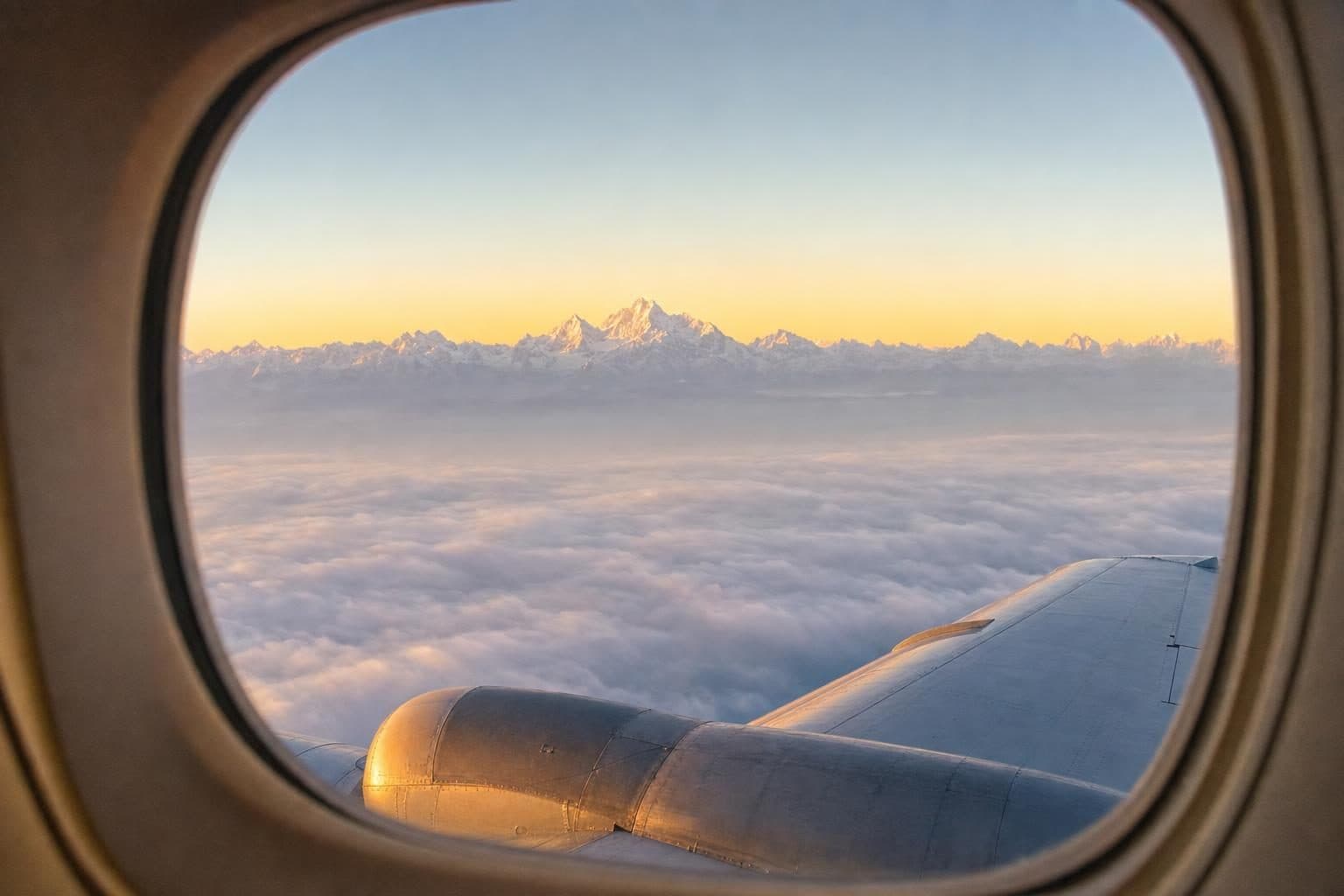
The Everest mountain flight is a roughly one-hour scenic flight from Kathmandu that runs parallel to the Himalaya for a window-seat view of Everest and the peaks around it, then lands you back where you started — no trekking, no landing on a mountain. It is the fastest way to see the world's highest mountains, and for travellers who cannot trek, often the only way. Here is what it costs, who flies it, and how to give yourself the best chance of a clear morning.
The short version
If you only read one section.
- It is a roughly one-hour flight from Kathmandu that flies out along the Himalaya and back, without landing. Everyone gets a window seat.
- Buddha Air and Yeti Airlines fly it every morning in season, leaving around 6:15–7:30 a.m. when the air over the mountains is clearest.
- Airlines charge foreigners and residents different fares for the same seat: about US$185 against NPR 10,335 on figures reported in early 2025. Agents today quote foreigners roughly US$180-250 depending on the airline and season, so treat any single price as indicative and confirm when you book.
- It flies only in good weather. Book it for the start of your trip so a cancelled flight can be rescheduled to another morning.
- The peaks lie to the north, so ask for a seat on the left flying out — but the planes fly half-full and the crew let you into the cockpit, so nobody misses the view.
What the flight actually shows you
The flight is a straight line east from Kathmandu and back. Once you are above the valley haze, the Himalaya fill the northern horizon: the plane runs parallel to the range so peak after peak passes the window, starting near Langtang Lirung and ending over Everest, Lhotse, Makalu and Chamlang at the far eastern end. Buddha Air counts around 20 named peaks on the route.
You do not land, and you do not get close to Everest the way a trek to Kala Patthar or a helicopter tour does — the aircraft stays well south of the peaks. What you get instead is the whole eastern Himalaya in one sweep, in an hour, in comfort. To make sure nobody misses out, the airlines sell only about half the seats, so every passenger has a window; the cabin crew also bring passengers up to the flight deck one by one for the head-on view through the cockpit glass.
Flying out from Kathmandu, the range is on the left of the aircraft; on the way back it is on the right. Ask at check-in for the side you want — some airlines seat you by booking order rather than choice.
What it costs
Nepal charges foreign visitors more than nationals for the same flight, as it does at most sights. The gap is large here, but the foreign fare is still modest for an hour beside Everest. These are the figures reported for the mountain flight; the airlines set the exact price at booking and it moves a little by season and airline.
| Passenger | Typical fare | Worth knowing |
|---|---|---|
| Foreign tourist | About US$180-250 per person | The same seat and flight as everyone else |
| Nepali national | NPR 10,335 | Passport or citizenship checked at the counter |
| Resident foreigner (expat) | The Nepali rate | Only with a non-tourist visa issued 6+ months before the flight |
Airlines and how to book
Two airlines fly the Everest mountain flight reliably: Buddha Air, which calls it the Everest Experience, and Yeti Airlines, which brands it the Everest Express. Both use ATR turboprops — Buddha Air flies 24-seat ATR 42s and 36-seat ATR 72s on the route — and both leave from Tribhuvan International Airport in Kathmandu. Other operators add flights in the busy autumn season.
Book directly on either airline's website, or let your hotel or a trekking agency arrange it — agencies charge a small mark-up but handle the airport transfer and the early start. Whichever way you book, you pay the same nationality-based fare, and you will need your passport at check-in: the airlines verify it, because the resident and Nepali fares are only for people who can prove they qualify.
The resident (expat) fare is not the tourist fare. Airlines give it only to foreigners living in Nepal on a non-tourist visa issued at least six months before the flight, and check the visa at the counter — arrive on a tourist visa expecting the low fare and you will pay the difference or be turned away.
The best season and time of day
Two things decide whether you see anything: the season and the hour. The flights go at dawn because the morning air over the Himalaya is stillest and clearest; by mid-morning cloud builds over the peaks. That is why every departure is scheduled between about 6:15 and 7:30 a.m.
For the season, autumn and the dry winter give the clearest skies and the sharpest peaks; spring is usually good too but hazier. Avoid the monsoon, when cloud sits on the mountains most mornings and flights are often cancelled. Whatever the month, weather can close in on any given day, so build a spare morning into your plans rather than booking the flight for the day you leave.
| Season | Months | Chance of clear peaks |
|---|---|---|
| Autumn | October–November | Best — clear, stable mornings |
| Winter | December–February | Very good — cold but sharp; some fog on the ground |
| Spring | March–May | Fair — good peaks but hazier air |
| Monsoon | June–September | Poor — cloud most mornings, frequent cancellations |
On the day
The flight is early and the airport is busy, so give yourself time. Check-in for a 6:15 departure means being at the terminal well before that; a taxi from Thamel takes about 20 minutes on empty morning roads. Take your passport for the fare check, a little cash for the airport, and a jacket — the dawn air is cold and the cabin can be too.
- Keep your camera or phone ready before take-off, and turn off the flash — it only reflects off the window.
- If you get motion sick, take something beforehand — the aircraft banks and turns along the range.
- Confirm your flight the evening before; dawn departures are the first to move if the forecast is poor.
- Ask whether the fare is refunded or the flight rebooked if it is cancelled for weather — policies differ by airline.
Is it worth it?
For most visitors the mountain flight earns its price. In an hour, without the altitude, cost or effort of a trek, you see Everest and a run of 8,000-metre peaks that otherwise take days to reach. It suits travellers short on time, families, older visitors and anyone who won't be trekking. The catch is the weather: you are buying a chance at a clear morning, not a certainty, which is why it belongs early in a trip with a spare day behind it.
If getting closer matters more than convenience, the alternatives are a trek to a viewpoint such as Kala Patthar, or a helicopter tour that lands for a mountain-view breakfast — both cost much more in time or money, and neither is covered here. For a first look at the high Himalaya, the fixed-wing mountain flight is the simplest choice.