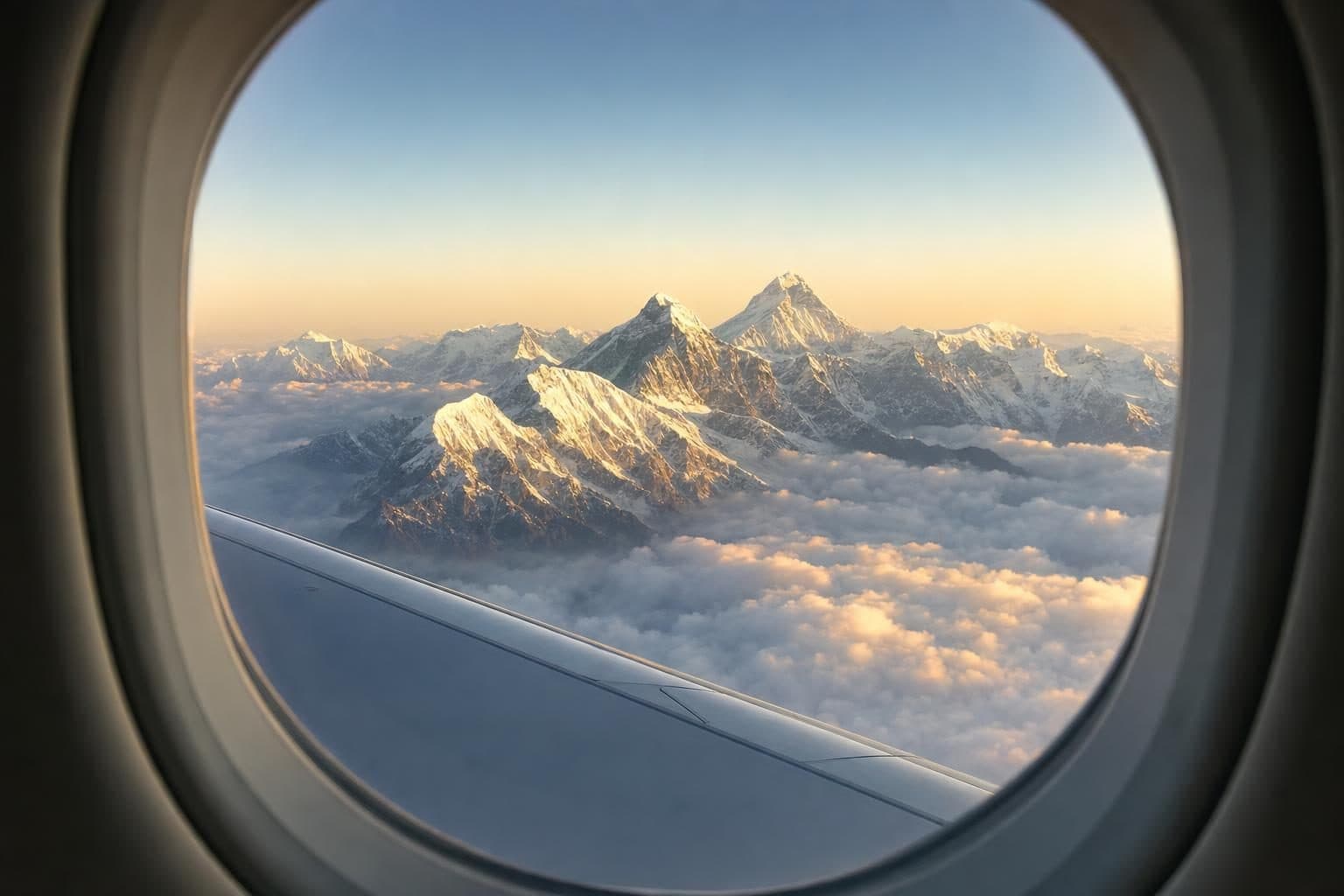
Nepal is easier to reach than its mountains suggest. There are no nonstop flights from the UK, the US or Australia, but a single connection through the Gulf, Istanbul or Asia gets you to Kathmandu, and the visa can be sorted online or on arrival. This guide covers the parts first-time visitors ask about most: how to route the flight, when to go, the visa, what happens when you land, and the domestic flights and permits that come after.
The short version
The essentials, each explained further down.
- Expect one stop. The main connections are Doha, Dubai, Istanbul, Delhi, Bangkok, Singapore, Kuala Lumpur and Hong Kong.
- A tourist visa costs USD 30 for 15 days, USD 50 for 30 days or USD 125 for 90 days. Get it online as an eVisa before you fly, or on arrival.
- Your passport needs at least six months' validity. Carry some US dollars in cash even if you plan to pay by card.
- October and March–April are the busiest months. Book flights as soon as your trek dates are fixed.
- Leave spare days in your plan. Mountain flights, including Lukla, are often delayed by weather.
- Most popular trekking routes require a licensed guide.
How to fly to Kathmandu
Almost every international visitor lands at Tribhuvan International Airport (KTM) in Kathmandu. There are no nonstop flights from the UK, the US or Australia; Istanbul is the only nonstop link to Europe. Plan on one connection, and compare total journey time as well as price — a cheaper fare with a twelve-hour layover is not always a saving.
Pokhara, the gateway to the Annapurna region, is getting its first regular international service: flydubai begins daily Dubai–Pokhara flights on 23 September 2026. For most trips, though, Kathmandu will still have far more choice.
| Connect in | Airlines to Kathmandu | Often suits |
|---|---|---|
| Doha | Qatar Airways | UK, Europe, US |
| Dubai | flydubai (also sold as Emirates codeshare) | UK, Europe, US |
| Istanbul | Turkish Airlines | Europe, US |
| Delhi | Air India, IndiGo | UK, US, combining with India |
| Bangkok, Singapore, Kuala Lumpur | Thai, Singapore Airlines, Malaysia Airlines, Batik Air | Australia, New Zealand, Asia |
| Hong Kong | Cathay Pacific | Australia, North America, East Asia |
When to go, and when to book
Nepal's two main seasons follow the weather. October is the busiest month of the year for arrivals, followed by March, April and November, when skies are clearest for trekking. The monsoon, roughly June to September, brings rain in the hills and cloud over the peaks, and winter is cold at altitude but quiet and clear.
Flight prices follow your own country's holidays as much as Nepal's seasons, so the busiest trekking months are not always the dearest to fly. The rooms, guides and domestic flights that fill up first are in Nepal itself: if you are coming for the spring 2027 season, book once your dates are fixed rather than waiting for a deal.
| Season | Months | What to expect |
|---|---|---|
| Autumn | Oct–Nov | Clearest views and the busiest trails. Dashain and Tihar festivals. |
| Winter | Dec–Feb | Cold at altitude, some high passes closed, fewer people. |
| Spring | Mar–May | Warm, rhododendrons in flower, the second trekking peak. |
| Monsoon | Jun–Sep | Rain, cloud and leeches in the hills; flight delays more likely. |
The visa: online or on arrival
Most nationalities, including British, American, European and Australian travellers, can get a tourist visa on arrival at Kathmandu. Since 2026 you can also apply online in advance for an eVisa (called an ETA), paying by card and receiving it by email; it has to be used within six months of being issued. Visa on arrival still works if you prefer it.
If you take the visa on arrival, you can save time by filling in the online arrival form before you fly, but no more than 15 days ahead — the barcode receipt expires after that. Otherwise the kiosks in the arrivals hall do the same job.
| Length of stay | Fee | Entries |
|---|---|---|
| 15 days | USD 30 | Multiple |
| 30 days | USD 50 | Multiple |
| 90 days | USD 125 | Multiple |
- Your passport must be valid for at least six months from arrival and machine-readable.
- Cards are accepted for the visa fee, but carry US dollars in cash as a backup in case the card machines are down.
- Border officials may ask to see your travel insurance and your first night's accommodation, so have both to hand.
What happens when you land
Kathmandu's arrivals process runs in a fixed order, and knowing it takes the stress out of a long queue after a long flight.
- 1. Arrival form: show your online form's barcode, or fill it in at a kiosk.
- 2. Visa fee: pay at the bank counter (skip this with an eVisa).
- 3. Immigration: visa-on-arrival passengers use counters 5–12, pre-issued visas 13–14.
- 4. Baggage, then customs: green channel if you have nothing to declare, red if you do. Declare cash above USD 5,000.
- Money: there are exchange counters and ATMs in the arrivals hall, but rates are poor. Change or withdraw only what you need for the first day.
- SIM card: Ncell sells tourist SIMs at the airport with your passport — NPR 595 for 7 days, 995 for 14 or 1,995 for 28 at the time of writing — and a tourist eSIM online.
- Getting to your hotel: use the prepaid taxi counter in arrivals for a fixed fare, or a hotel pickup. Ride-hailing apps such as Pathao and inDrive are widely used, though not yet formally regulated.
Domestic flights: Lukla, Pokhara and the weather
Most Everest treks start with a short flight to Lukla. In recent peak seasons those flights have left from Manthali (Ramechhap) rather than Kathmandu — a four-to-five-hour drive that usually starts in the small hours. Ask your agency which airport your flight uses before you book the night before.
Mountain flights are delayed or cancelled by weather often enough that you should plan around it: keep one or two spare days before your international flight home. Lukla flights also have a tight baggage limit — Tara Air allows 15 kg in total, 10 kg checked and 5 kg hand baggage.
Every Nepali airline is on the EU Air Safety List, which bars them from EU airspace. It is a judgement about oversight, not a ban on flying with them in Nepal, and there is often no practical alternative to a domestic flight — but it is worth knowing, and worth checking your travel insurance covers domestic flights.
Guides and permits for trekking
Since 2023, foreign trekkers on Nepal's popular routes — including Everest Base Camp, Gokyo, the Annapurna Circuit and Base Camp, Langtang and Manaslu — must hire a licensed guide, and the TIMS card is issued only through registered agencies. Local authorities in the Everest region have disputed the rule, so ask a registered agency what currently applies to your route rather than planning around solo trekking.
- TIMS card: NPR 2,000 for foreign trekkers.
- Sagarmatha (Everest) National Park: NPR 3,000; free for children under 10. A local municipality fee is also charged in the Khumbu.
- Annapurna Conservation Area Permit (ACAP): NPR 3,000.
Travel insurance for Nepal should cover trekking at the altitude you plan to reach and helicopter evacuation. Many standard policies stop at a lower altitude, so read the small print before you buy.